


The NBA Playoffs are usually described as a story about talent, coaching, and the perfect shot at the right moment. Underneath all of that, they’re something else too. They’re one of the most studied sleep deprivation experiments in professional sports. Once you see the playoffs that way, they start telling a much more interesting story about how much sleep actually matters. Including yours.
What the league figured out that most people haven’t
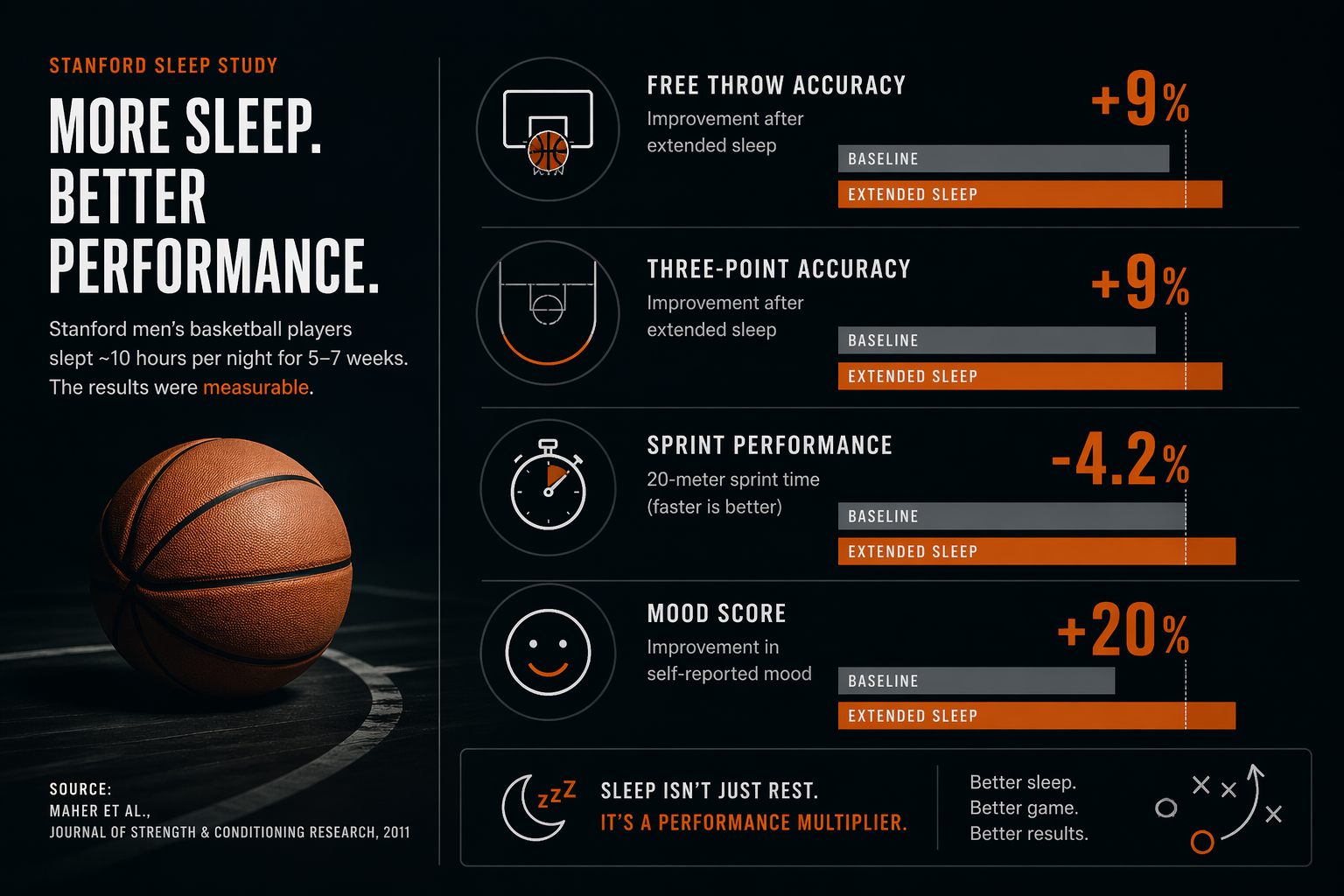
In 2011, researchers at Stanford ran a sleep study with the university’s men’s basketball team. The players kept their normal schedules for two weeks, then extended their sleep to about ten hours a night for five to seven weeks. The changes were significant.
Free throw accuracy improved by 9 percent. Three-point accuracy improved by about the same amount. Timed sprints got faster. Reaction times got sharper. Mood improved. Every measurable performance marker moved in the same direction.
For a professional player, a 9 percent shift in shooting accuracy is the difference between having a good series and having a career series. For the rest of us, it’s the difference between shooting 70 percent at the local gym and shooting 76 percent. Enough to change who wins the game.
What that study told the NBA was simple. Sleep is not a soft variable. It’s one of the most measurable, manageable, and valuable factors in athletic performance. The league has been building around that insight ever since.

The playoffs are where it all compounds
If sleep matters to performance, the playoffs are the worst place to lose it.
A deep playoff run covers up to four rounds, as many as 28 games, and in cross-country matchups, tens of thousands of miles in the air. Teams play across the country in a matter of days. Games end around 10 PM local time. Players shower, meet with press, and board a plane. Arrivals at the next city are often between 2 and 4 AM. The next day brings another practice, another travel day, or another game.
On top of that, there’s something researchers call the first-night effect. When a person sleeps in an unfamiliar room, part of the brain stays partially alert, watching for signs of danger. It’s an evolved response that made sense when unfamiliar rooms might have been caves. It doesn’t make sense in a hotel, but the brain does it anyway. The result is significantly less deep sleep during the first night in any new place. For an NBA team during the playoffs, almost every road game is a first night.
Stack the travel, the late arrivals, the short sleep windows, and the hotel effect. Repeat for eight weeks. By the Conference Finals, many players are operating with accumulated sleep debt that sleep researchers would describe as equivalent to going two full nights without sleep. They can still run. They can still dunk. But the parts of the brain that handle split-second decisions, pattern recognition, and fine motor accuracy are not working the way they normally would.
One of the most repeated findings in sleep research is that the people most affected by chronic sleep restriction often don’t realize how affected they are. Sleep debt hides from the person who has it.
What franchises now spend to fight it
Fifteen years ago, sleep science was barely discussed in professional basketball. Locker rooms still carried a version of “sleep when you’re dead.” That’s gone.
Today, most NBA franchises have a dedicated sleep specialist on staff or a standing partnership with a sleep science firm. Teams invest in circadian lighting in their training facilities, nap rooms for pre-game recovery, blackout curtains and customized mattresses that travel with the team, and wearable sleep trackers that many players wear nightly. Franchise investment in sleep science programs runs into the six figures annually for most teams.
The role itself didn’t exist in most front offices a generation ago. Now it sits on the org chart alongside strength coaching and nutrition.
What that investment reflects is a simple calculation. At the margin of elite performance, sleep is one of the highest-return health interventions a team can make. The league has been running the experiment for over a decade and has arrived at the same answer every time.
The part that applies to the rest of us
The interesting thing about that experiment is that the physiology the NBA is managing is exactly the same physiology every adult has. An NBA player’s brain responds to sleep loss the same way anyone’s does. The difference is what happens next.
When a professional athlete has a pattern of poor sleep, a specialist evaluates it. When an average adult has the same pattern, it usually goes unexamined. The stakes are different in a way worth pausing on.
For an NBA player, chronic poor sleep means worse games. For an average adult, chronic poor sleep can mean something more significant. Obstructive sleep apnea, a condition where breathing stops and restarts during sleep, affects an estimated tens of millions of American adults, and the majority of cases are undiagnosed. Over time, untreated moderate-to-severe sleep apnea has been linked to higher rates of hypertension, stroke, heart disease, and cognitive decline. The symptoms can be easy to dismiss. Loud or chronic snoring. Waking up tired even after a full night in bed. Daytime fatigue. Headaches in the morning. Many people have lived with some combination of those for years, assuming it’s just how they sleep.
The NBA’s version of the problem is measured every night. The average person’s version is often not measured at all.
The investment ladder, from the Finals to your bedroom
A courtside seat at an NBA Finals game can cost more than many people spend on any health intervention in their lifetime. An authentic jersey costs a few hundred dollars. A night out at a playoff watch party can reach a hundred easily.
A home sleep study, by contrast, is one of the more accessible diagnostic tests in medicine. It typically happens in your own bed, over one or two nights, with a small take-home device. In most cases, insurance covers it when a provider sees a clinical reason to order it. Out of pocket, it tends to cost less than an authentic jersey.
For people the study identifies as having sleep apnea, treatment options have expanded significantly in recent years. Some people use CPAP, the most common treatment, and do well with it. Some people benefit from dental appliances. Some people, for whom other options haven’t worked, may be candidates for newer approaches including implantable therapies.
None of that is the point of the story, though. The point is that the first step, the one the NBA has built an entire performance science around, is knowing what your sleep is actually doing. Most people don’t know. That’s not a failing. It’s just a gap in the system. The system tends to measure lungs when there’s a problem, heart rhythm when there’s a problem, blood pressure when there’s a problem. Sleep is a little different, because the problem is often silent and the person with the condition is, by definition, asleep when it happens.
The quiet point underneath all of this
The NBA is a useful mirror because the physiology the league manages so carefully is the same physiology every adult has. What professional players are protecting is performance. What the rest of us might be missing is something closer to long-term health.
Loud or chronic snoring, waking up feeling unrested, daytime sleepiness that coffee doesn’t fix, and morning headaches are worth paying attention to. They are some of the most common signs of sleep apnea, and they’re often the things people mention only in passing, as if they’re just part of getting older or being busy.
If any of that sounds familiar, it’s worth learning more. You can read about the four main symptoms of sleep apnea here. The first step is usually a conversation with a provider and, if appropriate, a sleep study that takes place in your own home. What the NBA has turned into an annual championship, the rest of us can turn into a reasonably straightforward health question. Most people who ask it are glad they did.